
Table of Contents
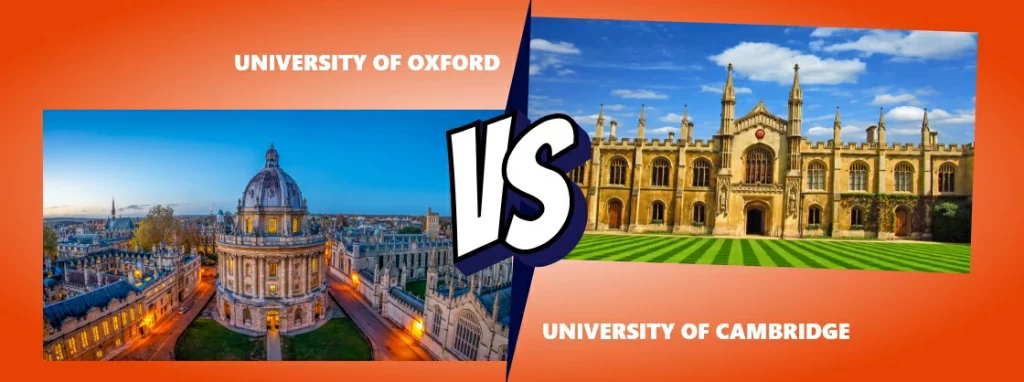
For centuries, University of Oxford and University of Cambridge have shaped the landscape of higher education, research, and global innovation, producing some of the greatest minds in history, from scientists and writers to politicians and economists. Both universities have a unique collegiate system, providing students with a tight-knit academic community and exceptional teaching methodologies. However, while they share many similarities, they also have distinct differences in course structures, rankings, tuition fees, student demographics, and subject strengths. Understanding these differences is essential for students who aspire to study at either Oxford or Cambridge, as their choice will significantly impact their academic journey, career opportunities, and overall university experience. This blog provides a detailed comparison of these two iconic institutions, covering everything from university rankings and academic programs to cost of living, scholarships, and subject strengths, helping prospective students make an informed decision.
Oxford vs Cambridge: Comparison
The University of Oxford and the University of Cambridge, collectively known as Oxbridge, are two of the oldest and most prestigious universities in the world. They have played a crucial role in global education, research, and innovation, producing some of the greatest thinkers, leaders, and scholars. Both universities have a distinctive collegiate system, where each college operates independently, offering housing, social spaces, and academic support. However, despite their historical prestige and global rankings, there are some key differences that set them apart. The table below provides a comprehensive overview of the fundamental characteristics of both universities.
| Aspect | University of Oxford | University of Cambridge |
| Year Established | 1096 (Oldest English-speaking university in the world) | 1209 (Founded by scholars fleeing Oxford) |
| Location | Oxford, England | Cambridge, England |
| Number of Colleges | 44 (Each with its own distinct traditions) | 31 (Smaller in number but equally autonomous) |
| Student Population | Approximately 24,000 (With around 45% international students) | Approximately 22,000 (With around 35% international students) |
| Notable Alumni | Stephen Hawking, J.R.R. Tolkien, Tony Blair | Isaac Newton, Charles Darwin, Stephen Hawking |
Oxford vs Cambridge: World University Ranking
Both Oxford and Cambridge consistently rank among the top universities in the world. These rankings consider factors such as academic reputation, faculty-to-student ratio, employer reputation, and research output. Oxford has frequently secured the top spot in global rankings, whereas Cambridge follows closely, maintaining its reputation for research excellence. Below is a summary of the latest world rankings for 2025:
| Ranking System | University of Oxford | University of Cambridge |
| QS World University Rankings | 3rd (Renowned for research and employability) | 5th (Strong in STEM and innovation) |
| Times Higher Education (THE) | 1st (Ranked the best university in the world) | 3rd (Ranked among the top for science and research) |
Oxford vs Cambridge: Courses Offered
Both Oxford and Cambridge provide a wide range of undergraduate and postgraduate programs across multiple disciplines. However, their teaching methodologies and course structures differ significantly. Oxford is particularly well-known for its tutorial-based teaching system, which involves one-on-one learning with a professor, whereas Cambridge follows a supervision-based approach, which includes small group sessions led by an academic expert. Oxford is known for its humanities programs, whereas Cambridge is a global leader in STEM fields. Below is a comparison Oxford and Cambridge academic disciplines and specialized programs.
| Discipline | University of Oxford | University of Cambridge |
| Humanities | Classics, English Language and Literature, History | Archaeology, Modern and Medieval Languages, Philosophy |
| Sciences | Biochemistry, Physics, Earth Sciences | Natural Sciences (Interdisciplinary program encompassing Biology, Chemistry, Physics), Engineering |
| Social Sciences | Economics and Management, Geography, Politics, Philosophy, and Economics (PPE) | Human, Social, and Political Sciences (HSPS), Land Economy |
| Arts | Fine Art, Music | Architecture, History of Art |
Oxford vs. Cambridge: Fees and Cost of Living
When choosing between the University of Oxford and the University of Cambridge, understanding the cost implications is crucial for prospective students. The financial investment goes beyond tuition fees and includes college fees, accommodation, food, travel, study materials, and personal expenses. Both universities have slightly different tuition structures based on the course type, domestic or international student status, and duration of study. Laboratory-based and medical courses tend to have higher tuition fees, while humanities and social sciences are relatively lower in cost. Additionally, the living expenses vary based on lifestyle choices, accommodation type, and city-specific costs. Below is a detailed breakdown of the expenses for students considering Oxford and Cambridge for the 2025-2026 academic year:
| Expense Category | University of Oxford | University of Cambridge |
| Tuition Fees (Overseas Students) | £35,260 – £59,260 per year (course-dependent) | £27,024 – £58,038 per year (course-dependent) |
| College Fees | Approximately £7,350 per year | Approximately £10,000 per year |
| Living Expenses | Estimated at £1,425 – £2,035 per month | Estimated at £1,240 – £1,650 per month |
Oxford vs. Cambridge: Scholarships
Both Oxford and Cambridge offer a variety of scholarships to support international and domestic students. These scholarships are designed to assist students with tuition fees, living costs, and research expenses. Many scholarships are merit-based, requiring exceptional academic performance, while others focus on financial need or students from underrepresented backgrounds. Some are fully funded, covering all costs, while others offer partial funding. Below is an overview of the most notable scholarships offered at both universities:
| Scholarship Name | Description |
| Rhodes Scholarship | Prestigious international scholarship for postgraduate students, covering tuition, living expenses, and travel costs. |
| Clarendon Fund | Offers over 130 full scholarships annually to academically excellent graduate students across all subjects. |
| Reach Oxford Scholarship | Available to students from low-income countries who cannot study for a degree in their home country. Covers tuition, living expenses, and one return flight per year. |
University of Cambridge Scholarships
| Scholarship Name | Description |
| Gates Cambridge Scholarship | Fully funded scholarship for outstanding international postgraduate students, covering tuition, living costs, and research funding. |
| Cambridge Trust Scholarships | Offers a range of scholarships to undergraduate and postgraduate students, supporting approximately 500 students annually. |
| Vice-Chancellor’s Award | Provides partial scholarships for PhD students demonstrating research excellence. |
Oxford vs. Cambridge: Subject Strengths
The University of Oxford and the University of Cambridge consistently rank among the top universities globally across multiple disciplines. However, their subject strengths differ, with Oxford excelling in humanities and social sciences and Cambridge leading in STEM (Science, Technology, Engineering, and Mathematics) disciplines. Both universities offer world-class research facilities, faculty expertise, and career opportunities for their students. Below is a detailed comparison of subject rankings for the University of Oxford and the University of Cambridge in 2025.
| Subject Area | University of Oxford Ranking | University of Cambridge Ranking |
| Arts & Humanities | 1st globally | 2nd globally |
| Engineering & Technology | 5th globally | 4th globally |
| Life Sciences & Medicine | 2nd globally | 3rd globally |
| Natural Sciences | 4th globally | 3rd globally |
| Social Sciences & Management | 3rd globally | 2nd globally |
Conclusion
When comparing Oxford vs Cambridge, it is evident that both institutions offer unparalleled academic excellence, extensive research opportunities, and access to a powerful global alumni network. However, the decision to attend either university should be based on individual interests, academic strengths, career goals, and preferred learning environments. Oxford excels in humanities, social sciences, and law, making it an ideal choice for students interested in philosophy, politics, history, and literature. On the other hand, Cambridge dominates in STEM fields, engineering, and natural sciences, offering cutting-edge research facilities and rigorous interdisciplinary science programs.
Cost considerations, scholarships, and city lifestyle also play a role in making the final decision. Oxford is slightly larger in terms of student population and number of colleges, while Cambridge is considered a more compact and science-focused environment. Both cities offer a rich cultural and academic experience, with Cambridge being slightly more affordable in terms of living costs. Choosing between them is not a matter of which university is “better,” but rather which one aligns more closely with your academic ambitions and personal aspirations. Regardless of the choice, any degree from either of these institutions guarantees an education that is highly respected worldwide, paving the way for a successful and impactful career.