



You’ve just landed in Australia, classes start soon, and you’ve set aside AUD 3,000 for your first month’s living costs, excluding tuition. Sounds manageable, right? Picture that money as a jar. Every expense below takes an envelope out, and the question is what remains at month-end. Published estimates for the cost of living in Australia for international students run from about AUD 1,700 to AUD 3,650 or more per month, depending on city, housing and lifestyle. Figures are in AUD and drawn from 2026 sources where available, with weekly rents converted to monthly. Treat AUD 3,000 as an illustrative scenario, not an official benchmark.
What Is the Average Cost of Living in Australia for International Students?
Jar balance: AUD 3,000, nothing spent yet.
Your AUD 3,000 challenge starts with a reality check. Accommodation is usually the biggest expense, city choice shifts it by hundreds of dollars, and tuition is a separate cost excluded here. The average cost of living in Australia for international students therefore depends on where and how you live, so the bands below are illustrative and tied to the detailed budget later in this guide.
- AUD 3,000 a month works out to about AUD 692 a week, or AUD 100 a day.
- Rent takes roughly 57% to 60% of each band (AUD 1,000 of 1,700; 1,500 of 2,500; 2,100 of 3,650).
- The gap between Hobart’s low estimate (AUD 1,450) and Sydney’s high estimate (AUD 3,650) is AUD 2,200 a month.
- ANU estimates AUD 24,000 to 28,500 for a Canberra academic year, or AUD 2,400 to 2,850 a month over ten months.
| Student lifestyle | Monthly living cost (AUD) | Typical arrangement |
| Budget-conscious | About 1,700 | Shared accommodation, home cooking |
| Moderate | About 2,500 | Student accommodation, regular transport |
| Higher-cost | About 3,650+ | Private apartment, more discretionary spending |
How Much Does Student Accommodation Cost in Australia?
Jar balance: AUD 3,000 minus a moderate AUD 1,500 rent leaves AUD 1,500.
Rent takes the first and biggest bite out of your AUD 3,000. Student accommodation in Australia is commonly cited at AUD 1,200 to 3,400 a month, though shared rooms in cheaper cities fall below that and Sydney private studios exceed it. Ranges in the table convert weekly rents using weekly × 52 ÷ 12, so you can compare them with monthly budgets.
- UNSW lists on-campus rooms at AUD 325 to 620 a week on a 52-week contract and AUD 390 to 570 on a 44-week contract.
- UQ’s independent residences cost AUD 401 to 439 a week with utilities included, against AUD 359 to 480 for purpose-built student housing.
- Hobart shared rentals start near AUD 150 a week, while Jane Franklin Hall at AUD 522 to 651 includes meals, Wi-Fi and bus travel.
- Homestays such as Bond University’s at AUD 355 to 400 a week include meals, internet and utilities.
- Where rent is not all-inclusive, bills add roughly AUD 95 to 350 a month in a shared home.
| Accommodation type | Monthly rent (AUD) | Best suited for |
| Shared room or house | 650–2,170 | Budget-conscious students |
| University accommodation | 1,250–2,700 | Campus convenience |
| PBSA (purpose-built student accommodation) | 870–3,200 | Managed facilities |
| Private studio | 1,750–4,300+ | Privacy |
| One-bedroom apartment | 1,500–3,550 | Independent living |
| Homestay | 1,000–2,200 | Meals and local support |
What Is the Monthly Cost of Living in Australia for International Students?
Jar balance: after rent, AUD 1,500 left in the moderate scenario.
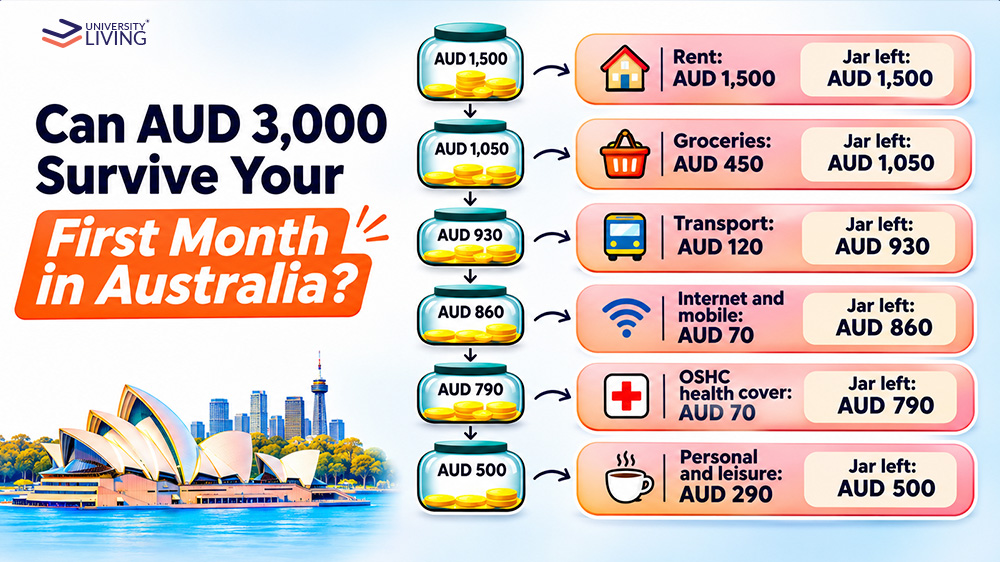
After rent, everyday spending decides whether the month survives. The average cost of living in Australia for international students stays consistent here because these three budgets add up to the lifestyle bands above. Bills are included in rent for the first two; only the higher-cost budget pays utilities separately.
- Fixed costs in the moderate budget (rent, internet, OSHC) total AUD 1,640, which you cannot trim after arrival.
- Variable costs (groceries and transport) total AUD 570 and respond most to your habits.
- Optional personal spending is AUD 290, the first line to squeeze if rent runs high.
- The higher-cost budget adds AUD 600 more rent and AUD 200 for separate utilities, which pushes it AUD 650 above the jar.
- The moderate budget finishes with AUD 500 spare.
| Expense (AUD/month) | Type | Budget | Moderate | Higher-cost |
| Accommodation | Fixed | 1,000 | 1,500 | 2,100 |
| Utilities | Fixed | Included | Included | 200 |
| Internet and mobile | Fixed | 50 | 70 | 120 |
| Groceries | Variable | 350 | 450 | 500 |
| Transport | Variable | 60 | 120 | 230 |
| OSHC | Fixed | 70 | 70 | 70 |
| Personal, clothing and leisure | Optional | 170 | 290 | 430 |
| Total | 1,700 | 2,500 | 3,650 |
How Much Do Groceries and Food Cost in Australia?
Jar balance: AUD 450 for groceries leaves AUD 1,050.
Next stop: the supermarket. A reference estimate is about AUD 450 a month, roughly AUD 104 a week, inside the commonly cited AUD 80 to 150 a week. Diet, location and shopping habits move the total, and eating out changes it fastest.
- Study Adelaide lists AUD 60 to 100 a week for groceries and AUD 30 to 50 for eating out.
- A Curtin University source puts a single person’s average grocery spend near AUD 111 a week.
- Brisbane estimates split food into AUD 250 to 350 groceries, AUD 80 to 150 eating out and AUD 40 to 80 delivery a month.
- Hobart lists AUD 350 to 500 for groceries and AUD 120 to 250 for dining out monthly.
- Weekly grocery bills run about AUD 100 to 150 in Sydney, AUD 80 to 120 in Melbourne and AUD 70 to 110 in Perth (Study Adelaide, November 2024).
- Five Perth fast-food meals a week at AUD 15 to 25 cost about AUD 100 at the midpoint, nearly the whole weekly grocery estimate.
How Much Do Transport, Utilities and Other Expenses Cost?
Smaller bills quietly erode the buffer, so each deserves a look. In the moderate scenario the five items below take AUD 550 of the jar, and each one varies sharply by city and housing type.
- Reference ranges at a glance: transport AUD 20 to 230, utilities AUD 150 to 510, internet and mobile about AUD 120.
- OSHC is a reference AUD 65 to 80 a month, and personal spending AUD 150 to 550.
- These reference ranges are wider than any single city’s, so the sections below use city-specific data.
Public Transport
Jar balance: AUD 120 for transport leaves AUD 930.
Transport is the most city-dependent small cost of Living in Australia. Queensland caps Translink fares at 50 cents a trip, Perth gives international students a 40% concession, and Adelaide’s concession MetroCARD costs AUD 57.80 a month. Sydney is dearer, with estimates of AUD 100 to 200 a month.
- Brisbane’s lowest published monthly cost starts at AUD 23.
- Canberra estimates range from AUD 5 to 30 a week (ANU) up to AUD 220 a month in another guide, so check your route.
- Hobart lists AUD 70 to 120 a month, and Perth about AUD 15 a week with the concession.
- Car costs run AUD 50 to 75 a week in Adelaide, or AUD 150 to 260 a week in Monash and Griffith estimates.
Electricity, Gas and Water
Jar balance: included in rent here, so AUD 930 remains.
Utilities depend almost entirely on housing type. Purpose-built and on-campus options often bundle them into rent, while shared private rentals bill them separately. In the moderate scenario they are included, so the jar does not move.
- UNSW’s shared-house estimate is AUD 35 to 40 a week for gas and electricity.
- ANU lists AUD 22 to 71 a week.
- UQ puts off-campus utilities at AUD 282 to 350 a month, among the higher published figures.
- Curtin’s source gives about AUD 216 a month for a two-bedroom apartment, usually split between occupants.
Internet and Mobile
Jar balance: AUD 70 leaves AUD 860.
About AUD 120 is a fair reference for a standalone home with its own broadband and a mobile plan. Shared houses and student accommodation spread the broadband cost, so the moderate budget uses AUD 70. Many providers include Wi-Fi in rent.
- Hobart combines mobile and internet at AUD 45 to 90 a month.
- Brisbane estimates run AUD 80 to 130, and UQ lists phone and internet at AUD 15 to 150.
- Curtin’s source gives about AUD 84 for internet and AUD 25 for mobile.
Overseas Student Health Cover
Jar balance: AUD 70 leaves AUD 790.
OSHC is generally mandatory for international students holding a Student visa, and many students pay it upfront rather than monthly. The reference estimate of AUD 65 to 80 a month equals AUD 780 to 960 a year. Premiums vary by provider, cover type and visa length, so compare quotes before arrival.
- UQ lists OSHC at about AUD 1,200 to 1,400 a year, above the reference.
- Another Brisbane guide gives AUD 450 to 600 a year, so quotes differ widely.
- Hobart’s one-off arrival costs of AUD 1,500 to 2,000 include OSHC, a rental bond and household set-up.
Entertainment and Personal Expenses
Jar balance: AUD 290 leaves AUD 500 at month-end.
Social life is where budgets bend. The reference range of AUD 150 to 550 a month covers leisure, clothing and personal care, and the moderate scenario allows AUD 290. UQ notes student discounts of up to 50% at participating venues, so planning outings around concessions stretches the same amount further.
- A student cinema ticket costs around AUD 20 (UQ), against about AUD 25 standard (Curtin).
- Gyms run AUD 10 to 20 a week, or AUD 60 to 70 for premium clubs.
- Hobart lists entertainment at AUD 100 to 200 and clothes and personal care at AUD 150 to 300 a month.
- Sydney guides put socialising at AUD 200 to 350 a month, against AUD 100 to 250 in COL Brisbane.
What Is the Cost of Living in Sydney vs Melbourne?
Jar balance: the same AUD 3,000, two different cities.
If you had the same AUD 3,000 in Sydney and Melbourne, where would your money go further? Using shared accommodation and identical categories for both cities (from published COL Sydney and COL Melbourne 2027 guides), Sydney costs more, mostly through rent. The cost of living in Sydney vs Melbourne also varies by suburb, so use the ranges as a guide.
- Sydney runs about AUD 290 to 580 higher in total, in line with Study Adelaide’s AUD 400 to 600 rent gap (November 2024).
- Shared accommodation differs by AUD 83 at the low end and AUD 267 at the high end.
- Personal spending is the largest non-rent gap: AUD 200 to 350 in Sydney against AUD 80 to 150 in Melbourne.
- Study Adelaide puts monthly transport at AUD 160 to 200 in Sydney and AUD 90 to 120 in Melbourne.
- AUD 3,000 covers about 95% of Melbourne’s range but only about two-thirds of Sydney’s.
| Expense (AUD/month) | Sydney | Melbourne |
| Shared accommodation | 1,083–2,167 | 1,000–1,900 |
| Groceries | 250–500 | 250–450 |
| Transport | 100–200 | 80–250 |
| Utilities and extras | 150–300 | 120–250 |
| Internet and mobile | 80–130 | 45–70 |
| Personal expenses | 200–350 | 80–150 |
| Total | 1,863–3,647 | 1,575–3,070 |
Which Are the Cheapest Cities in Australia for International Students?
Jar balance: which city leaves the most in the envelope?
Smaller cities can stretch cost of living in Australia of AUD 3,000 further, though not in every category. Study Adelaide reports Adelaide as about 16% cheaper than Sydney and 13% cheaper than Melbourne, using November 2024 figures. That shapes the cost of living in Australia for international students beyond the big two, but compare each expense before assuming any city is cheaper.
- Brisbane: shared rooms cost AUD 175 to 250 a week, giving a computed total of about AUD 1,350 to 2,200.
- Hobart: off-campus totals run AUD 1,450 to 2,600, with AUD 1,500 to 2,000 in one-off arrival costs.
- Perth: a computed total of about AUD 1,950 to 2,600, helped by the 40% transport concession.
- Canberra: ANU estimates AUD 312 a week for shared rent and AUD 673 for living alone.
- Adelaide: Study Adelaide’s total of AUD 350 to 700 a week equals AUD 1,500 to 3,050 a month.
How Much Money Is Required for an Australian Student Visa?
Jar balance: the visa threshold is not the jar.
Your AUD 3,000 is a personal budget or planned cost of living in Australia for a month, while the visa figure is a threshold. Reports citing Home Affairs list AUD 29,710 for 12 months of a single applicant’s living costs, about AUD 2,476 a month. Study Australia notes real living costs can be much higher, so treat the visa figure as a minimum. Confirm current amounts on the Department of Home Affairs website.
- A partner adds AUD 10,394 and each child AUD 4,449, with AUD 13,502 a year for each school-age child.
- Applicants lodging from inside Australia may need a travel component of around AUD 1,000.
- First-year tuition from your Confirmation of Enrolment must also be shown, and is commonly cited at AUD 25,000 to 40,000 a year.
- Your jar is AUD 36,000 a year, about AUD 6,290 above the visa living figure.
- These cost of living in Australia ammount are reported as unchanged since 10 May 2024.
Can International Students Work Part-Time to Cover Living Expenses in Australia?
Jar balance: can wages refill the envelope?
Eligible Student visa (subclass 500) holders can generally work up to 48 hours per fortnight during study terms and unlimited hours in scheduled breaks, subject to visa conditions. Masters by research and PhD students are exempt once their course starts. Jobs are not guaranteed, so fund rent and OSHC from savings first.
- A fortnight is any 14-day block starting on a Monday, and the cap is visa condition 8105.
- At the AUD 26.44 minimum wage from 1 July 2026 (a 6% rise), 48 hours is about AUD 1,270 before tax, or about AUD 2,750 over a month if hours were always available.
- Paid placements required by your CRICOS course are exempt, while other paid internships count toward the cap.
- Genuinely unpaid voluntary work generally does not count.
- The cap was not raised to 60 hours from 1 July 2026, despite online claims.
How Can International Students Save Money While Living in Australia?
Jar balance: how to finish the month with more.
Back to your AUD 3,000: small choices change the outcome. Cutting the cost of living in Australia for international students is mostly about housing and habits, and the room you choose is the biggest lever. Platforms such as University Living let you compare room types and inclusions before committing.
- Share and compare inclusions. UNSW estimates a Sydney one-bedroom unit at AUD 180 to 530 a week above a shared house, and Adelaide rent is AUD 200 to 400 a month below Sydney’s.
- Shop with a list. Holding groceries at the AUD 450 reference rather than AUD 650 saves about AUD 200 a month.
- Use concessions. Queensland’s 50-cent fares and Perth’s 40% discount beat Sydney’s AUD 100 to 200 transport range.
- Buy second-hand books. UQ’s average of AUD 1,212 a year is about AUD 101 a month.
- Budget set-up costs separately. UNSW lists AUD 3,600 one-off for a shared house and AUD 5,800 for a one-bedroom unit.
- Track weekly spending and keep an emergency fund.
Is AUD 3,000 Per Month Enough to Live in Australia as an International Student?
Jar balance: the month-end verdict.
Often yes for shared living, but not everywhere. Excluding OSHC and one-off costs, the ranges above lead to different outcomes by city, and your first month is the riskiest because set-up costs arrive before your first pay. Compared with the average cost of living in Australia for international students, AUD 3,000 is comfortable only with disciplined housing choices.
- Brisbane: the jar keeps AUD 807 to 1,632 at month-end.
- Hobart: AUD 400 to 1,550 remains.
- Melbourne: the result runs from AUD 70 short to AUD 1,425 spare.
- Sydney: from AUD 647 short to AUD 1,137 spare, and private studio rent alone can pass AUD 2,100.
- Set-up costs: UNSW’s AUD 3,600 shared-house set-up estimate would exceed the entire jar.
Did the AUD 3,000 Budget Survive?
Back to your jar. Shared accommodation in cities such as Brisbane or Hobart keeps it intact, Melbourne is tight at the top end, and Sydney works only if you share. Rent, city choice, groceries, transport and personal spending decide the outcome, and set-up costs can hit before your first pay. Understanding the cost of living in Australia for international students before choosing a city lets you budget with evidence. Compare real rents near your campus and keep a month’s buffer.
Cost of Living in Sydney vs Other Australian Cities for International Students
Jar balance: the same AUD 3,000, eight cities.
The same AUD 3,000 buys a different month in each city. Ranges below are monthly estimates for shared or standard accommodation, excluding tuition and OSHC, drawn from UNSW, ANU, Study Adelaide, UQ, Bond University, Curtin University, a Hobart guide and the Sydney and Melbourne guides above. Weekly figures are converted using weekly × 52 ÷ 12, and sources use slightly different expense categories, so treat all figures as indicative.
- At the top of each range, the jar keeps AUD 800 in Brisbane, AUD 400 in Hobart and Perth, and AUD 200 in Canberra.
- At the top of each range, it runs AUD 50 short in Melbourne and Adelaide, AUD 250 short on the Gold Coast and AUD 650 short in Sydney.
- At the bottom of each range, every city leaves at least AUD 800, the smallest margin being Canberra’s.
- Accommodation is a separate column and is not added to the total again.
| Australian city | Monthly living cost (AUD) | Monthly accommodation (AUD) | Key affordability consideration |
| Sydney | 1,850–3,650 | 1,100–2,150 | Higher accommodation costs, particularly near central universities |
| Melbourne | 1,600–3,050 | 1,000–1,900 | Shared accommodation can help reduce monthly expenses |
| Brisbane | 1,350–2,200 | 750–1,100 | Living costs depend on proximity to universities and the CBD |
| Adelaide | 1,500–3,050 | 600–1,200 | Shared housing and transport options may support lower budgets |
| Perth | 1,950–2,600 | 1,100–1,750 | Rental costs vary by suburb and distance from campus |
| Canberra | 2,200–2,800 | 1,100–1,450 | Accommodation availability and transport influence expenses |
| Hobart | 1,450–2,600 | 720–1,400 | Rental availability can affect affordability |
| Gold Coast | 2,150–3,250 | 850–1,500 | Costs vary between coastal suburbs and university neighbourhoods |
Freuently Asked Questions
Is AUD 2,000 per month enough for an international student in Australia?
It can be, with shared accommodation in a lower-cost city such as Brisbane, Hobart or Adelaide and home cooking. In Sydney or Melbourne, AUD 2,000 leaves little room once rent, OSHC and transport are paid, and private housing would not fit.
How much bank balance is required for an Australian student visa?
Reports citing Home Affairs list AUD 29,710 for a single student’s 12 months of living costs, plus first-year tuition and travel. Partners and children add more. Rules can change, so confirm on the Home Affairs website before applying.
Can international students cover living expenses through part-time jobs?
Partly, for some students. Visa holders can generally work 48 hours a fortnight during term, about AUD 1,270 before tax at minimum wage, but jobs are not guaranteed. Plan to fund rent and OSHC from savings first.
Does student accommodation in Australia include utility bills?
Often, but not always. Many purpose-built providers include utilities and internet in rent, while some university halls and private rentals charge separately. Check the inclusions list before signing, because separate bills can add roughly AUD 95 to 350 a month in a shared home.
Is Sydney more expensive than Melbourne for students?
Generally yes. On a shared-accommodation basis, Sydney estimates run about AUD 290 to 580 a month higher, mostly because of rent. Suburb, housing type and lifestyle still change the result, so compare specific areas near your campus.
How much money does an international student need per month in Australia?
Published estimates run from about AUD 1,700 to 3,650 or more a month excluding tuition, depending on city, housing and lifestyle. Shared accommodation with home cooking sits near the lower end, while private apartments and frequent dining out push towards the top.


