

Nursing Courses in Australia 2026
Table of Contents
Studying in Australia sounds exciting! With so many students choosing nursing, Australia has a good choice for students who want a respected nursing qualification. The healthcare system is strong, and there are steady job opportunities for nurses.
In this guide, we’ll talk about types of nursing courses, low-cost nursing universities, fees, entry requirements, and scholarships. Along with studies, second most important thing is finding a good student accommodation in Australia. We will help you with all that in this blog.
Why Australia is Best for Studying Nursing?
Over 45,000 international students are enrolled in nursing programs across Australia in 2026, and the number will increase in future. With these many students, workforce forecasts show that nursing demand is still rising steadily due to many factors.
- Chronic nurse shortage: Australia is facing a shortage of qualified nurses due to an ageing population, rising healthcare needs, and workforce burnout.
- Globally recognised nursing degrees: Australian nursing programs follow strict accreditation standards. This makes the qualification respected both locally and internationally.
- Paid clinical placements: Several universities and healthcare providers offer paid placements or paid support roles during training. This helps a lot, as you can gain experience while earning.
- Strong post-study work & PR pathways: Nursing aligns well with post-study work options and skilled migration pathways, depending on eligibility and state demand.
- High employability across sectors: Graduates are not limited to hospitals. There are many opportunities in sectors like aged care, mental health, disability services, community health, and rural healthcare.
If you want a degree that leads to real jobs, practical experience, and long-term stability, nursing in Australia remains one of the safest study choices in 2026. Plus, it’s always better to plan your city and student accommodation in Australia early because good options near universities and training hubs get booked fast.
Is Nursing in Demand in Australia? (2026 Outlook)
In 2026, nursing remains one of Australia’s most in-demand careers. Due to an ageing population, rising healthcare needs, and staff shortages, more and more nurses are needed. For international students, this is a great opportunity as nursing is highly in demand, and it’s well respected.
What the demand looks like in 2026:
- Healthcare needs are rising faster than supply: Australia’s population is ageing rapidly, increasing demand for nurses in aged care, chronic disease management, and home-based care.
- Workforce burnout and retirements: A large portion of the current nursing workforce is approaching retirement age, while older nurses are facing burnout.
- Nursing roles remain on skilled occupation lists: Registered and enrolled nursing roles are there on skilled occupation lists, keeping nursing relevant for post-study work and migration planning (without any guarantees).
- Stronger demand outside major cities: Regional and rural healthcare services face deeper shortages, often offering more stable job openings and lower competition for graduates.
- Multiple entry points for graduates: Demand exists not only in hospitals but also in community health, mental health services, disability care, and aged care facilities.
Must Know Fact: Australia is expected to have over 10,000 nursing vacancies per year through 2030, with the highest demand in aged care, mental health, and regional healthcare.
Types of Nursing Courses in Australia
Australia offers nursing courses at different levels to cater everyone, from those who are starting fresh to grads from other fields. Each course leads to specific nursing roles, has different study durations, and affects your post-study work and career opportunities.
Diploma of Nursing
This is an entry-level course that prepares students to work as Enrolled Nurses (ENs). It’s best for those who are just starting, but it has limited pathways to permanent residency unless you choose to continue your studies later.
Bachelor of Nursing
The most popular option among students, the Bachelor of Nursing leads directly to Registered Nurse (RN) roles. It’s the best choice for international students because it offers strong post-study work opportunities and better prospects for long-term careers in Australia.
Master of Nursing
Best for students who already have a degree in another field, the Master of Nursing provides an accelerated route into the nursing profession. It’s perfect for international students because it fast-tracks entry into Registered Nurse roles and meets the strong demand for qualified nurses.
Wondering which is best for you?
If you want a quicker entry into the workforce with basic nursing roles, a Diploma might work. For long-term career growth, post-study work options, and better PR chances, a Bachelor of Nursing is usually the safest choice. If you already have a degree, a Master of Nursing is the fastest way to become a Registered Nurse in Australia.
Planning your Bachelor of Nursing in Melbourne? Start preparing early and begin your study abroad journey.
Nursing Course Comparison
Here’s a table to help you choose the types of degree that is best for you:
| Course Type | Duration | Average Fees (International Students) |
| Diploma of Nursing | 12-24 months | AUD 12,000 – 20,000 total |
| Bachelor of Nursing | 3-4 years | AUD 34,000 – 46,000 per year |
| Master of Nursing | 1.5-2 years | AUD 46,000 – 55,000 per year |
With this comparison you can easily decide which course will suit you the best and the one you should go for. Now, let’s move on to eligibility criteria, so you can get an idea of what it takes to study nursing in Australia.
Eligibility Criteria for Nursing Courses in Australia for International Students
Every country has their entry requirements, even every college has different criteria. With the level of study, whether Diploma, Bachelor, or Master, the requirements may change. Here is all about the requirements needed for nursing to study in Australia:
Academic Qualifications
- Diploma of Nursing: You just need to complete your 12th Subjects like Biology, Chemistry, or Math students are preferred more. Some universities ask for a minimum GPA of 5.5 or 50 percent.
- Bachelor of Nursing: Similar to the diploma, but this is the most common choice for international students. Completing your 12th with relevant science subjects is required , and GPA requirements can vary by university.
- Master of Nursing for non-nursing graduates: A recognized bachelor’s degree in nursing, health sciences, or a related field is required. Some programs also ask for professional experience.
English Language Requirements
Since nursing is a communication-heavy field, international students must meet both university admission and AHPRA registration requirements.
| Requirement | IELTS | PTE Academic | TOEFL iBT |
| University admission | Overall 6.5, no band below 6.0 | Overall 65, no skill below 65 | Total 90-95, section minimums vary |
| AHPRA registration | Overall 7.0, no band below 7.0 | Overall 65-70 | Total 98, with section minimums: Reading 24, Listening 24, Speaking 23, Writing 27 |
Higher scores can make professional registration much easier and reduce delays when starting clinical placements.
Health and Safety Checks
- Police clearance or criminal record check
- Health assessments for clinical placements
Fulfilling these requirements from the beginning helps in building your future nursing career in Australia.
Cost of Studying Nursing in Australia
Studying nursing in Australia can be expensive but if you have an idea of upcoming cost, it will help. Here’s what international students should expect in 2026.
| Type of Cost | Approx. (AUD) | Approx. (AUD) |
| Tuition Fees | Diploma of Nursing | 12,000 – 20,000 (full course) |
| Bachelor of Nursing | 34,000 – 46,000 per year | |
| Master of Nursing | 46,000 – 55,000 per year | |
| Additional Costs | Uniforms & gear | 300 – 600 |
| Clinical checks | 150 – 400 | |
| Textbooks / study materials | 500 – 1,000 | |
| Overseas Student Health Cover (OSHC) | 500 – 800 |
Want to know how to save money while studying in Australia? Start by exploring low-cost student accommodation options.
Scholarships & Financial Support for Nursing Students
Studying nursing in Australia can be a burden, but there are plenty of ways to make it more pocket friendly. Here are some of the types of support and scholarships in Australia for international students:
- University-level nursing scholarships: Many Australian universities offer merit-based or need-based scholarships for nursing students, covering part of tuition fees or living costs.
- Government or state programs: Certain states offer grants or fee reductions for students who commit to working in regional or high-demand healthcare areas after graduation.
- Part-time work: International students can work up to 48 hours while studying. Doing part-time jobs in Australia can help cover daily expenses.
Best Universities for Nursing in Australia
Choosing the right university is an important step for anyone planning to study nursing in Australia. With many well-known institutions offering high-quality education and hands-on clinical training, there are some of the best options you can consider:
| University / College | Course Name | Duration | Tuition Fees (AUD) |
| University of Notre Dame Australia | Bachelor of Nursing | 3 years | 38,818 per year |
| James Cook University | Master of Nursing | 1.5-2 years | 37,536 total |
| Central Queensland University (CQU) | Bachelor of Nursing | 2 years | 50,280 total |
| Flinders University | Graduate Certificate in Acute Care Nursing | 1 year | 30,400 total |
| Edith Cowan University (ECU) | Bachelor of Science (Nursing) | 3 years | 42,800 per year |
| University of Southern Queensland | Bachelor of Nursing | 3 years | 34,280 per year |
Tip: When choosing a university, consider proximity to hospitals and affordable student housing to make your study experience smoother and more convenient. Whether you are choosing Sydney, Melbourne, Brisbane, Perth or Adelaide, your study abroad journey is complete with the right student accommodation in Australia.
Confused about which Australian city to study in 2026? Here are the Top 10 Australian Cities for Students, check them out now.
AHPRA Registration & Licensing for Nurses in Australia
To work as a nurse in Australia, you need AHPRA registration. AHPRA (Australian Health Practitioner Regulation Agency) makes sure that all nurses meet professional standards and can practice safely. You must be aware that you cannot work as a registered nurse without it. Usually after graduation, once your degree and English requirements are complete.
Here are the steps you should follow after graduation:
- Complete your nursing degree.
- Gather documents: transcripts, clinical placement proof, ID, English test scores.
- You can apply online and just pay the registration fee.
- Then receive your license.
Congratulations! You’re a nurse now.
Tip: Check AHPRA requirements to avoid any delays.
Career Opportunities After Nursing in Australia
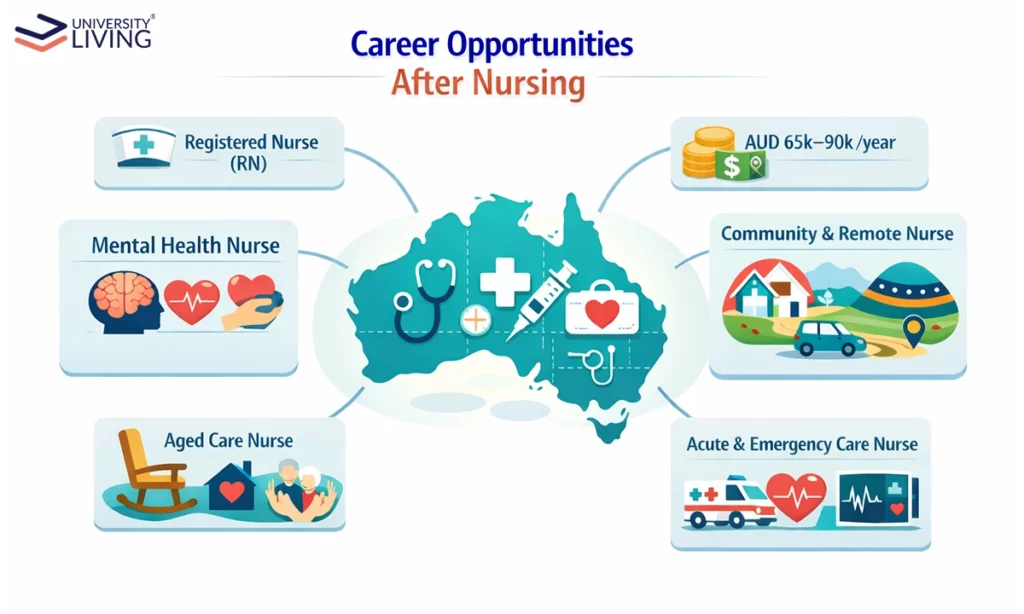
Nursing in Australia offers many options for both local and international nurses. Registered nurses can work in hospitals, clinics, or community health centres, and can earn around AUD 65,000-90,000 per year. Mental health nurses support patients with mental health needs, while aged care nurses care for the elderly in homes or facilities. Community and remote nurses work in rural areas, often with travel or housing benefits.
Permanent Residency Pathways for Nurses in Australia
Nursing is PR-friendly due to strong demand across Australia. International graduates can start with a Post-Study Work Visa (Subclass 485), which allows temporary work and a path to permanent residency. Nurses are on the Skilled Occupation List (SOL), and studying or working in regional areas can increase chances for migration. Government support and opportunities in aged care, mental health, and remote areas make it easier for nurses to gain PR.
Student Accommodation for Nursing Students in Australia
Platforms like University Living make it easier to find verified student housing near top universities that are safe and preferred by a lot of students, so you can move in easily. We provide help at every step from choosing the right place to booking and even moving in.
Skip the stress! Book your student accommodation with University Living today!
Frequently Asked Questions
Can international students work while studying nursing?
Yes, typically up to 48 hours per fortnight during term and full-time during breaks, subject to visa conditions.
Is nursing a good PR option in Australia?
Absolutely. Nursing is on the Skilled Occupation List, and PR pathways exist through skilled migration and regional sponsorship.
Is nursing stressful for international students?
Nursing can be demanding due to clinical placements and shift work, but support systems and structured schedules help manage stress.
Can I book accommodation before arriving in Australia?
Yes, many verified platforms allow pre-arrival booking to ensure smooth relocation.