
Table of Contents
Think, 24 students are sitting in a waiting room at a visa application centre. And at the end of the day, 23 of them are coming excited about the Visa approval. However, what about that 1 person? Often, the difference between success and setback isn’t only luck, sometimes it’s preparation. That one applicant may have missed a key step in presenting a clear, complete, and convincing application. It is called the Triad of Visa Certainty.
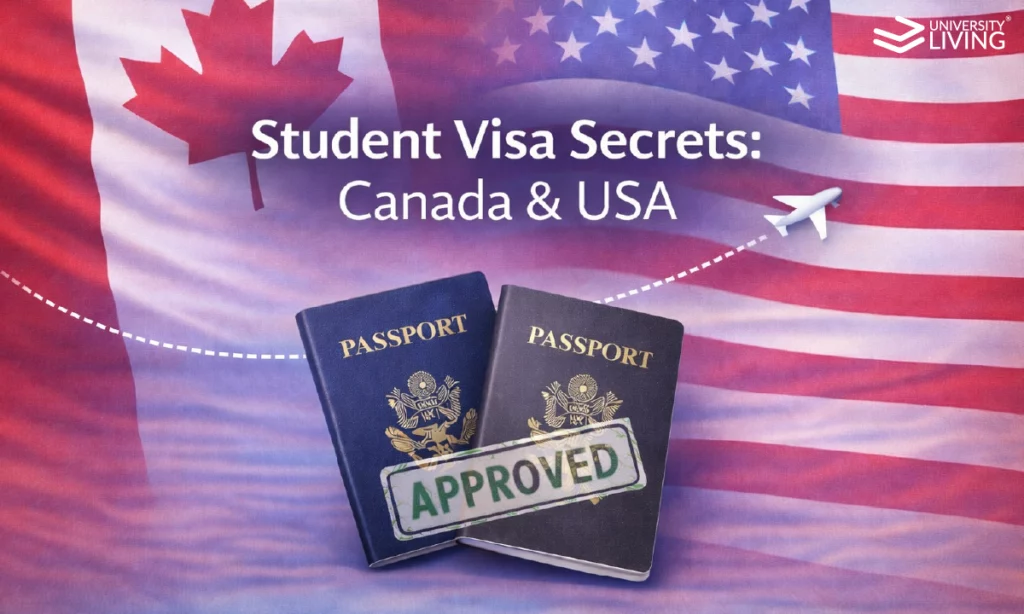
Therefore, this blog is strategically designed as the Canada USA student visa guide. Plus, it will cover every aspect for an international student, from the visa strategy to student accommodation abroad.
However, before digging directly into the solution or Visa strategies for international students, we must first understand the main reasons for student visa rejection.
Unfiltered Expert Insight: On The Living Pod, student mobility expert Mr. Saurabh Arora shares the proven strategies for visa approval that help students succeed with Canada & USA visas.
Why Do International Students Get Rejected for Canada & USA Student Visas?
For any student dreaming of getting their education from the top-tier universities of Canada or the USA, who does not wish to be involved in the infinite loop of the Triad of Visa Certainty. They directly start looking for solutions without understanding what matters more behind the rejection. However, we must start with the causes first:
Financial Insufficiency & Gaps (38% of refusals)
This is the largest single instance of a student visa refusal. The problem isn’t always a lack of funds; it’s how funds are presented in your sheet. The red flags students must avoid to get the visa approved are:
- Large last-minute deposits without explanation
- Unclear sponsor relationship or income source
- No proof of fund origins (tax docs, pay slips)
Lack of Genuine Intent (32% of refusals)
Officers must believe you’re coming primarily to study, not for secondary motives. Therefore, this Canada USA student visa guide provides you with cause for concern, so that it cannot affect your academic pathway:
- Unrelated program choice without explanation
- Education downgrade (e.g., Master’s to Diploma)
- No clear career benefit in home country
Weak Home Ties (22% of refusals)
A student visa is temporary by design. Officers need proof that you’ll return home after studies. Strong ties aren’t just stated, they’re proven with tangible evidence of a life waiting for you, whether family, property, career opportunities, or community roles. So that students must look for these below written negative indicator:
- Little family/property ties in home country
- Unstable job history or vague future
- No post-graduation job offers or commitments
Documentation Errors (8% of refusals)
These refusals occur due to preventable mistakes such as blurry scans, unsigned forms, or inconsistent details across documents. Such errors signal carelessness and can lead to refusal regardless of your eligibility. Since they’re fully within your control, meticulous preparation is your simplest safeguard. Therefore, students must avoid:
- Inconsistent personal details across forms
- Missing translations or signatures
- Blurred/unreadable documents
Apart from this, some Visa rejections happen because of the 5th factor, “Gut Feeling”. So, try not to be nervous or inconsistent in the interview, and keep your statements aligned with your documents.
However, most refusals are due to unclear stories, not unmet rules. Let’s now discuss the visa strategies for international students so that they can focus on their career goals, not only on the visa application process.
Proven Strategies for International Students for Canada & USA Visa
As you know, what to avoid if you are looking for a student visa, so we must walk through the best plan for your visa success. Therefore, we dive into actionable, expert-backed visa strategies that have helped thousands of students secure Canadian or U.S. student visas. Most importantly, this Canada USA student visa guide can work for you, too.
These strategies are built around what we call the Triad of Visa Certainty. Below mentioned are three pillars that immigration officers look for in every strong application:
- Financial Clarity & Stability
- Academic Purpose & Career Alignment
- Strong, Documented Home Ties
Let’s break down each Pillar with our top 05 visa strategies for international students to make your visa application smooth:
Strategy 1: Master the Financial Narrative
Your finances should tell a clear, logical story, not just show numbers. Here are the best things you can do to master the financial statements clear to study abroad
- Start early: Maintain consistent bank balances for at least 4–6 months before applying.
- Explain every large deposit: If a significant amount appears, attach a brief note explaining its source (e.g., “Fixed deposit maturity on 2026” or “Sale of family property, deed attached”).
- Use affidavits for sponsors: If parents or relatives are funding you, include a notarized sponsorship letter and proof of their income (tax returns, salary slips).
- Show liquid assets: Tuition + living expenses should be readily available, not locked in long-term investments without withdrawal proof.
Why it works: This strategy works because officers aren’t just checking out a box. Most fundamentally, they’re assessing risk. A transparent financial history reduces their perceived risk that you’ll run out of money and work illegally.
Strategy 2: Craft a Compelling Study Plan
Your study plan is your story. Make it specific, logical, and future-focused. Plus, be clear why any particular course you are choosing and why not others. Also, follow this Canada USA student visa guide:
- Connect the dots: Clearly link your past education/work experience to your chosen program.
- Be program-specific: Mention exact courses, professors, or research facilities at your university that align with your goals.
- Address gaps or shifts: If switching fields, explain why. Example: “My engineering background gives me the analytical skills needed for an MBA in Technology Management.”
- Highlight home-country benefit: Explicitly state how this education will help you professionally back home.
Why it works: Because it shows how focused you are as a student. Above all, getting an education is your only motto. A strong narrative proves genuine intent because you’re there to study, not just to immigrate.
Fun Fact: Mr. Meti Basiri, CEO and Co-Founder of ApplyBoard, highlights that 21% of Canadian entrepreneurs are taking immigrants as their workforce. This showcases how international talent plays a key role in Canada’s startup ecosystem.
Strategy 3: Build & Showcase Home Country Ties
One of the main reasons why the applications get rejected is the fact that your visa officer is thinking that you are planning to immigrate there only. Thus, they need tangible proof that you’ll return, and it’s non-negotiable. Therefore, students planning to study abroad and taking student accommodation must do:
- Document assets: Include property papers, family business registrations, or inheritance documents.
- Show family dependents: If you have aging parents or younger siblings relying on you, state it clearly.
- Secure a job prospect: Even a letter of interest from an employer in your home country helps.
- Demonstrate community roles: Leadership in local organisations, volunteer work, or professional networks.
Why it works: This strategy showcases your strong ties to reassure officers that you have compelling reasons to return, reducing overstay risk.
Strategy 4: Perfect Your Documentation
Small errors create big doubts. Meticulousness matters. This is very important because even when you show anything to anyone, you must double-check it. When it comes to the case of an international student visa, you must triple-check all your documents before submitting them. Plus, you must do
- Create a checklist: Visa application requirements + country-specific documents.
- Uniform details: Ensure your name, date of birth, and address match exactly across all forms.
- Certify translations: Any non-English/French documents must include certified translations.
- Quality over speed: Scan documents clearly, check for missing signatures, and validate passport expiry dates.
Why it works: This will work because it demonstrates your professionalism with Clean, organised submissions and respect for the process.
Strategy 5: Prepare for the Human Element (The Interview)
Every student applying for a U.S. student visa must go through an in-person interview with a consular officer. For U.S. visas especially, the interview can make or break your application. Thus, students must do student visa interview preparation with the following tips
- Practice, don’t memorize: Be ready to explain your plans naturally.
- Bring physical evidence: Carry key documents (admission letter, financial proofs, home tie evidence) to the interview.
- Stay calm and consistent: Align your answers with what’s in your application.
- Dress professionally: First impressions subtly influence credibility.
- Why it works: Confidence and consistency validate the story your documents tell.
Bonus Strategy
You don’t have to navigate this alone. We, University Living not only help you find Student Housing Canada or Student Housing USA but often provide visa support resources or checklists. Additionally, listening to experts like Mr. Saurabh Arora on The Living Pod can provide insider insights that generic guides miss.
Final Suggestions
The application for an international student visa is not just a formality, but it’s your first test in demonstrating clarity, attention to detail, and forward planning. Officers aren’t looking for perfect applicants; they’re looking for genuine, prepared, and credible students. This Canada-USA student visa guide suggests:
- Start Early
- Be consistent
- Seek Feedback
- Stay organized
And once your visa is approved, don’t delay your next critical step: finding safe, convenient student accommodation abroad with University Living.
Frequently Asked Questions
How much bank balance is needed to study abroad in USA or Canada?
Enough to cover first-year tuition + living costs. However, consistency and source matter most in your bank statement.
Is IELTS/TOEFL mandatory to take student visa for Canada or USA?
Usually yes. Check your university’s requirements, such as visa officers, visa officers to verify admission validity.
What types of student accommodation are available?
Students get multiple student housing options with University Living, such as PBSAs, sharing apartments, private rooms, en-suite and many more.
Is the visa interview compulsory to study in USA or Canada?
Yes, for USA (F-1). For Canada, it’s less common but possible if the officer has questions.
How to prove I’ll return home after getting my Education done in the USA or Canada?
Show property papers, a job offer for after studies, family dependents, or business ties in your home country.